From the Big Game to your brand: 5 advertising trends to apply in 2026
There have been a lot of memorable “Big Game” commercials over the years, and it’s debatable which one stands out as the most entertaining. But while most people just watch the ads for fun, marketers can look to them as a lesson in the latest advertising trends.
In 2026, several key themes emerged from the season's championship game advertisements. WebFX looks at what marketers can learn from championship game advertising trends this year.
Some of these Big Game marketer trends have existed for decades, but continue to be relevant today. Others are newly on the rise. But all of them are valuable to learn about.
1. Mass reach requires mass relevance
In today’s advertising world, hyper-targeting is the norm. Most brands aren’t trying to reach everyone — they’re trying to reach a highly specific group.
That’s what makes ads during the championship game so interesting. They’re one of the last remaining examples of true mass advertising — a single message broadcast to an enormous, diverse audience.
Look at just a few of the brands that invested in that reach this year:
- Pepsi
- Squarespace
- Lay’s
- Levi’s
What do all these brands have in common? Broad product appeal. Almost anyone watching the game could realistically become a customer. And therein lies the real lesson: Mass exposure only works when your product’s relevance scales with the audience.
If your product solves a universal problem (e.g., food, clothing, or search engines), mass awareness can drive a high return on investment (ROI). But if your offering is niche, local, or specialized, reaching millions of uninterested viewers isn’t a strategy — it’s waste.
SMB takeaway
For most small and mid-sized businesses, the goal isn’t mass reach. It’s market dominance within a clearly defined segment.
Instead of focusing on total reach, brands often consider the following questions:
- How can we reach the highest-intent audience?
- Where does our ideal customer spend the most time?
- Can we own attention within our niche?
In today’s landscape, precision often beats scale.
2. Celebrity cameos are as valuable as ever
Featuring celebrities in Big Game ads is nothing new, and as this year’s advertising trends show, it’s not going anywhere. To name just a few examples from 2026, we saw:
- Emma Stone looking for an available domain name on Squarespace
- Taika Waititi counseling a polar bear for Pepsi
- Sabrina Carpenter building her dream man out of Pringles
- Andy Samberg singing about Hellmann’s mayo
And that’s not even to mention the Dunkin’ ad that featured a bevy of de-aged ’90s stars, from Ben Affleck to “Seinfeld”’s Jason Alexander to Matt LeBlanc and Jennifer Aniston from “Friends.”
All told, it’s clear that big brands continue to find value in star power. Of course, these are giant corporations that can afford to throw around millions of dollars to get big celebrities. Your business, on the other hand, may not have the budget for Sabrina Carpenter.
But you might still benefit from smaller “celebrity” endorsements in the form of — for example — influencer partnerships. Whether or not this is the right choice for you depends not only on your budget, but also on what you sell and who you partner with.
SMB takeaway
Small businesses shouldn’t try to pour their whole marketing budget into getting a celebrity cameo. Instead, if you want to add some star power to your marketing material, consider partnering with online influencers. A few examples of this might include:
- A supplement brand collaborating with a TikTok gym influencer for educational content about ingredients.
- A clothing boutique partnering with an Instagram fashion influencer for outfit styling reels.
- A plant nursery teaming up with a plant care influencer for beginner plant care tips.
Of course, influencer partnerships won’t necessarily make sense for every business. You’ll have to assess your budget, brand, and industry to determine if it’s a good choice for you.
3. Weirdness can set brands apart
A lot of brands take a very safe approach with their advertising, making sure not to ruffle any feathers or do anything too “out there” with their brand. For many businesses, that’s the right choice. But one of the biggest Big Game advertising takeaways from this year is that sometimes, weird is better.
Some of the most “out there” ads this year included:
- A MANSCAPED ad featuring singing balls of shaved chest hair.
- A Svedka ad featuring AI-generated dancing robots (more on that later).
- A Skittles ad featuring Elijah Wood dressed as a horned, three-legged creature.
The advantage of making such weird ads is that people remember them. That’s why there’s a long history of strange commercials surrounding this event (for instance, the memorable 2016 Doritos ultrasound commercial). For some brands, that makes weird advertising the way to go.
But this isn’t the right move for everyone. If all your existing branding focuses on your professionalism and expertise, randomly putting out a bizarre or edgy ad is probably a bad move. Ultimately, you’ll have to make the decision based on how you want to present your brand.
SMB takeaway
Small and mid-sized businesses (SMBs) often benefit from being intentional about branding.
Think about the types of products or services you provide, and the type of audience you sell to. Based on those, do you want your brand to be perceived as:
- Elegant and prestigious?
- Fun and laid-back?
- Professional and to-the-point?
Whatever it is, ensure that your advertising is consistent with that brand. And if that means making your ads a little weird, don’t be afraid to lean into that.
4. AI is impacting ads — for better or worse
One of the biggest championship game ad trends from 2026 is AI. Many of the ads that we saw this year featured AI in some capacity, marking a new development in the field of AI marketing.
There are two sides to this trend. The first is that several ads this year were promoting AI tools — Google’s Gemini, Anthropic’s Claude, and OpenAI’s Codex were among the most prominent. That indicates an increased focus on AI promotion by tech companies.
But the other side of this trend, and arguably the one that sparked more conversations, concerns the use of AI-generated video ads. Interestingly, one of the biggest conversations around AI in Big Game advertising came from an ad that neither used nor mentioned AI at all — namely, the Pepsi ad.
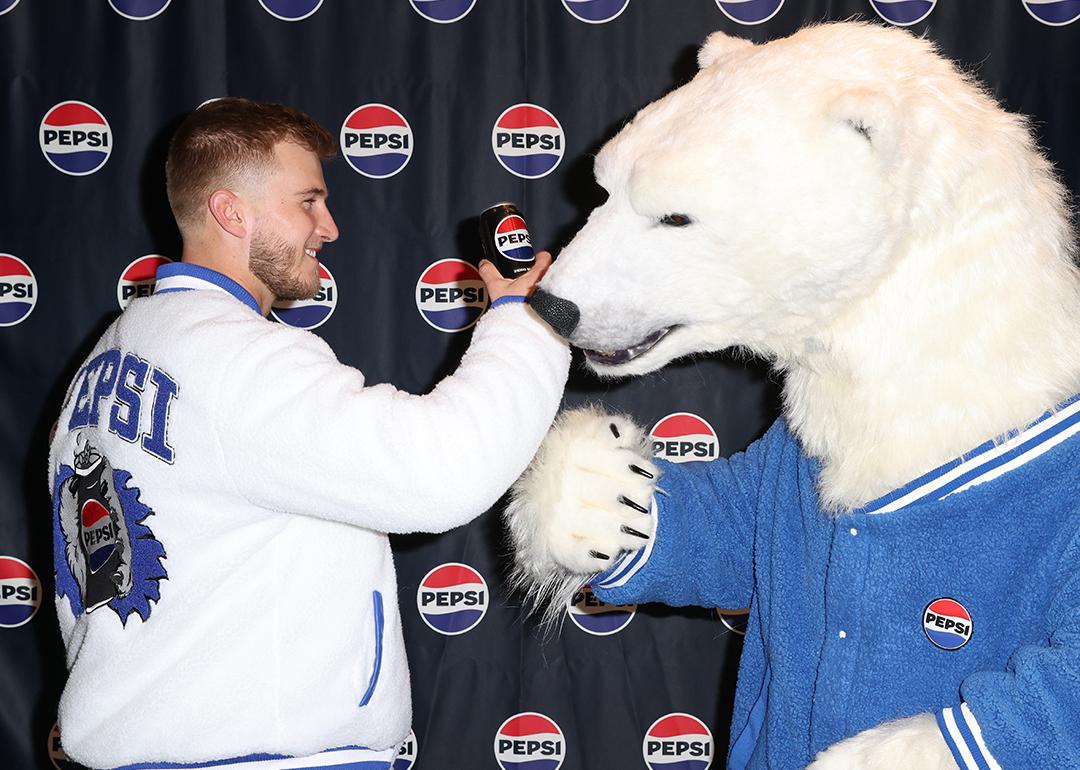
The ad in question features a CGI polar bear, and many people were quick to praise Pepsi for not creating it with AI. The reason this is so notable is that Coca-Cola’s two biggest ads in the last two years have been almost entirely AI-generated, resulting in a ton of blowback. And since Pepsi’s ad specifically targeted Coke’s branding, it invited comparisons between the two.
Compare the top YouTube comments under Coke’s most recent AI ad versus those under Pepsi’s Big Game ad. Almost every comment under both videos highlights people’s frustration with Coca-Cola’s use of AI-generated video, and their resulting desire to buy from Pepsi instead.
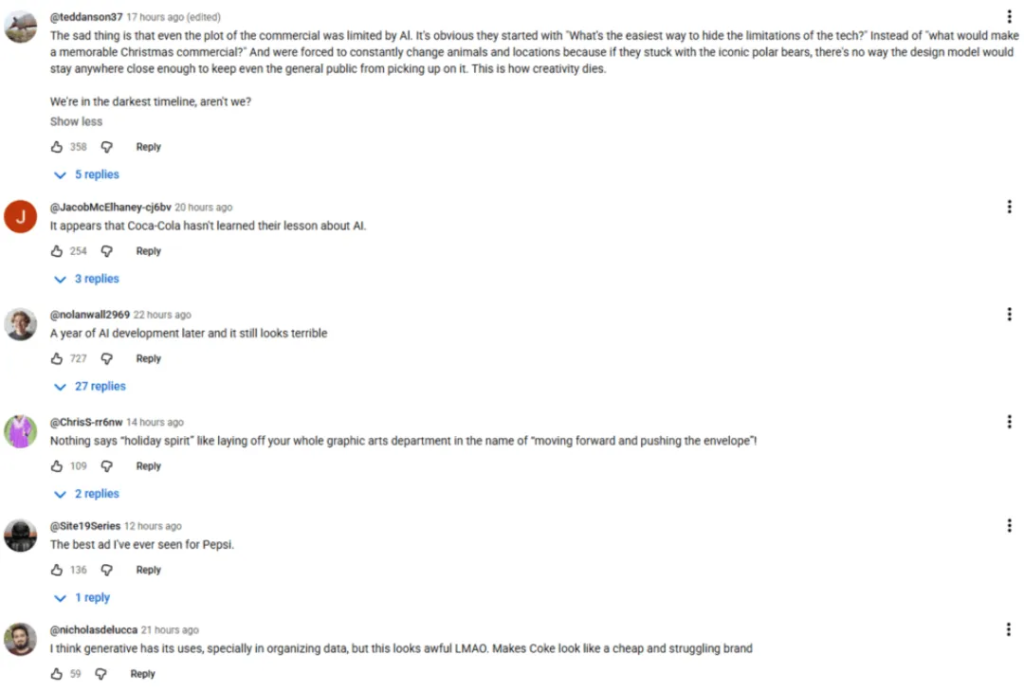
On the other side of the spectrum from Pepsi’s ad, meanwhile, was the ad for the vodka company Svedka, which was fully AI-generated. As with the Coca-Cola ads, many people reacted negatively to it. (Notably, the comments under Svedka’s YouTube video have been turned off, but you can still see some of the blowback beneath NBC’s video on the topic.)
It’s hard to know what this means for the future of AI-generated ads. The day may well come when the blowback to these ads is all but gone. But at least right now, the response to Pepsi’s ad versus Svedka’s seems to suggest that your brand will be better received if it relies primarily on human-made content rather than generating video ads entirely with AI.
On the other hand, if your goal is purely to drive attention — regardless of whether that attention is positive or negative — AI-generated ads will likely do the job.
SMB takeaway
When deciding whether or not to use AI-generated video in advertising, small businesses should be aware that they’ll likely get blowback for it. So the question is, is that blowback worth it?
If your sole priority is to grab attention, AI video might do the job. But if it does, it won’t happen on the same scale as it has for brands like Coca-Cola. Those brands have such huge audiences that they can afford to make a portion of those audiences mad in exchange for attention.
But for SMBs, it’s a lot riskier. There’s always the possibility that you’ll drive away your audience entirely. For that reason, be very cautious if you choose to use AI video. For many small businesses, it may be wiser to avoid it altogether.
5. Omnichannel storytelling boosts awareness
In days gone by, championship game ads often stood on their own. You’d see the ad on TV, and that’d be it. Today, though, advertising has moved beyond that. It’s true that this year’s ads showed during the game, but that was only one piece of the puzzle.
The majority of the biggest championship game ads this year were released online before the game itself, some even weeks in advance. And even before that, many brands released teasers for the full ads, just as a movie studio might release a teaser for a trailer.
Additionally, even after the game ended, these brands continued to use the ads to generate attention. Some even used components of those ads in other parts of their marketing — Pepsi, for example, featured their CGI polar bear prominently in their social media profile pictures and banners.
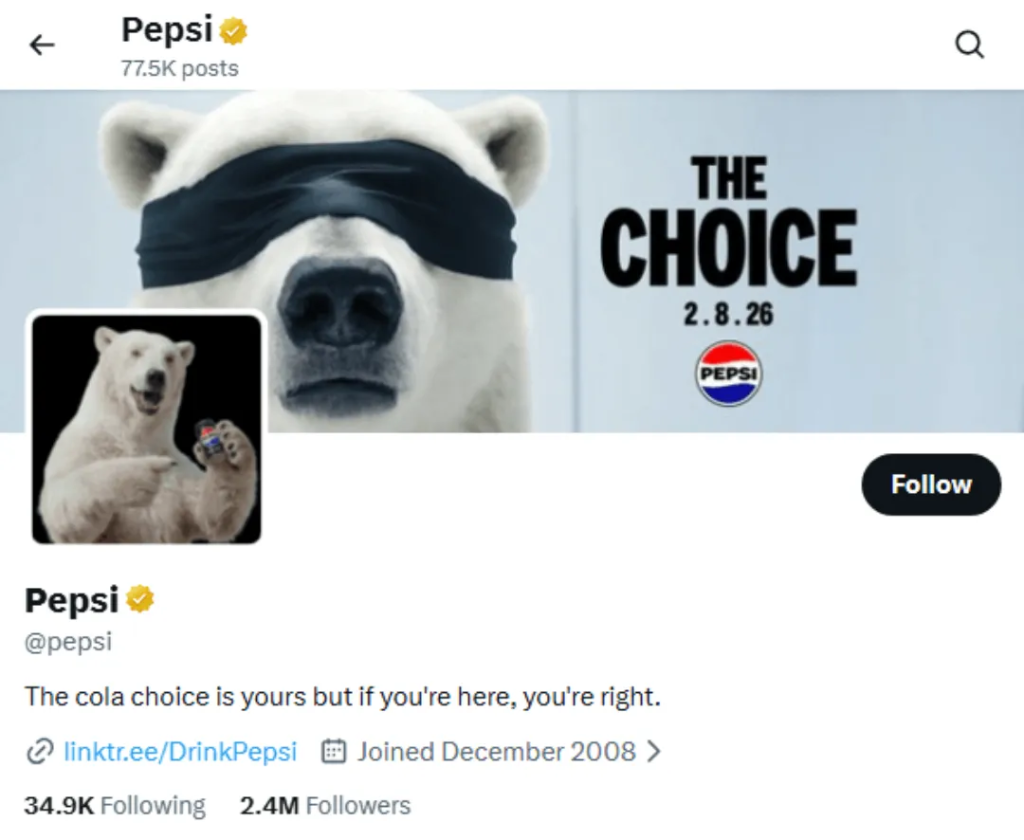
All of this speaks to the way branding has evolved to focus on long-term, omnichannel storytelling rather than isolated commercials. Adopting this approach is one way brands attempt to stay ahead.
Integrating the same messaging from a video ad into other components of marketing creates a larger, omnichannel campaign. That ensures that even when users switch between different channels, they’ll continue to receive that same messaging, moving them toward a conversion.
SMB takeaway
For small businesses as well as large ones, omnichannel marketing campaigns are increasingly common. When you build a campaign, don’t just limit it to a single channel. You can integrate the same branding and messaging across multiple aspects of your marketing, such as:
- Your paid ad landing pages.
- Your social media posts and banners.
- Specific pages on your website.
- Your marketing emails.
As users move from channel to channel, they’ll see a single, consistent campaign message across all of them. That will result in more conversions and revenue overall.
This story was produced by WebFX and reviewed and distributed by Stacker.